
EPC projects rarely fail inside engineering, procurement, logistics or construction. They fail at the interfaces between them. Make those handovers visible and give each one an owner, and you stop modules waiting on a quay for a drawing, a permit or a crane nobody ordered.
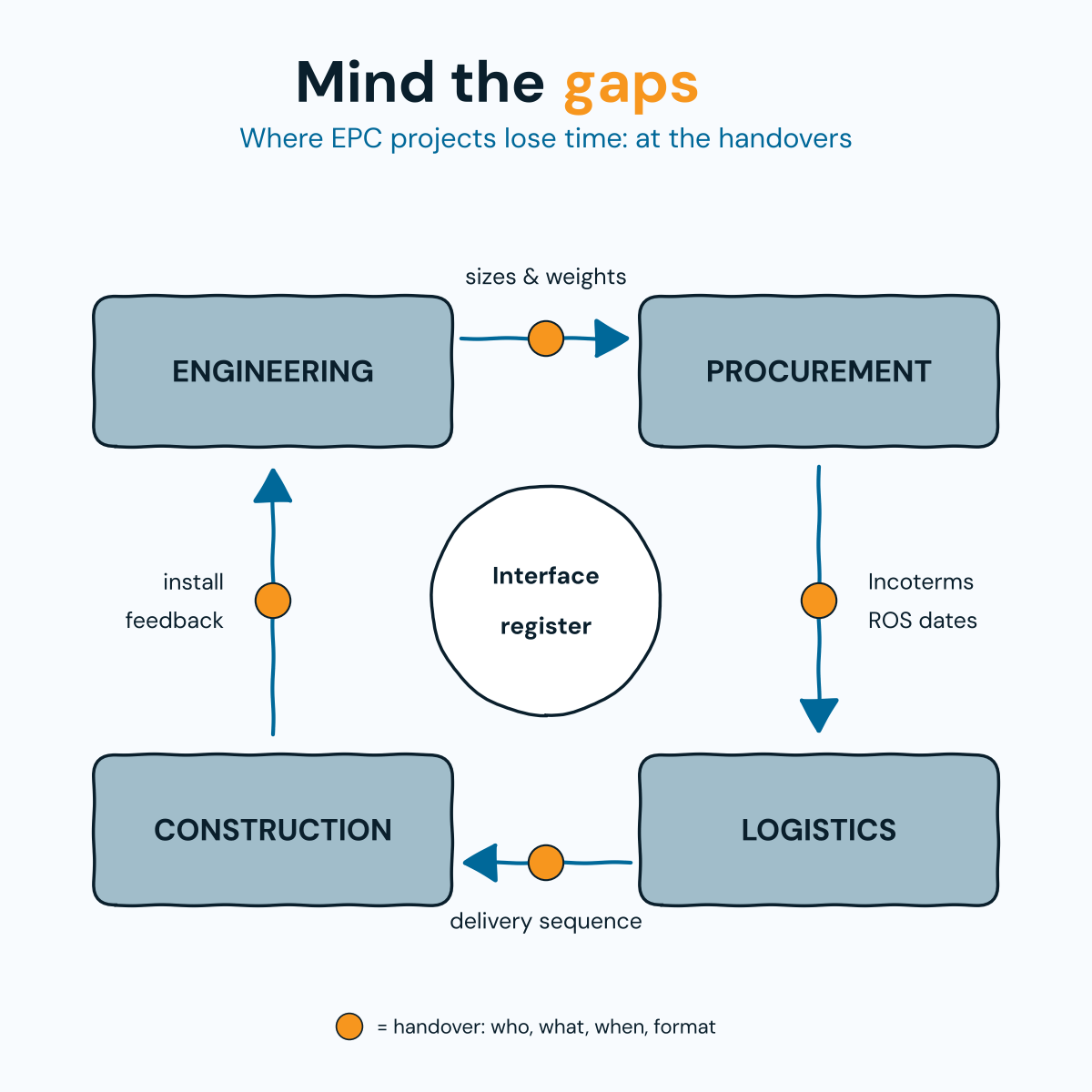
Why interfaces are the weak spot of EPC logistics
The whole idea of EPC is that one contractor owns engineering, procurement and construction, so the owner only has one throat to choke. Inside that contractor, though, you still have four disciplines with four schedules, four sets of systems and four ideas of what "done" means. For engineering, done is a released drawing. For procurement, a signed purchase order. For logistics, a delivered package. For construction, equipment standing on its foundation and working. Nobody designed those four definitions to line up.
Logistics sits right in the middle. We inherit what engineering and procurement decided, and we hand over to construction. That puts the logistics team in the best seat to spot a gap early, and often in the only seat from which it can still be fixed cheaply.
Four handovers that go wrong on almost every project
- Engineering to logistics: dimensions, weights, centres of gravity, lifting and lashing points. A module that grows a few decimetres during detailed design can lose you a road route or a barge option. Treat transport envelopes as a design input, not an appendix someone fills in later.
- Procurement to logistics: delivery terms, packing and preservation requirements, documentation. If it is not in the purchase order, you will not get it, or you will pay a variation for it. Incoterms, packing specifications and packing list requirements belong in the PO before it is issued.
- Logistics to construction: the required-on-site (ROS) date, delivery sequence and laydown capacity. Late is expensive, but so is early. A module parked on a laydown area for months runs up rent, preservation, inspections and security.
- Construction back to engineering: erection sequence and lifting method set the limits on module size and weight. That feedback tends to arrive after the design is frozen, and logistics gets the bill.
Interface management in EPC logistics that actually works
Interface management does not need a new department. The approaches I have seen work are mostly common sense applied with discipline.
Make interfaces visible. A simple interface register for each handover: what information, from whom, to whom, by when and in what format. For logistics the core is transport data per item: dimensions, weight, centre of gravity, lifting and lashing points, dangerous goods and the ROS date.
Give every interface one owner. An interface with two owners has none. One name per line, and that name also appears in the schedule.
Plan backwards from site. Construction sequence drives the ROS date. The ROS date drives the departure date and the transport mode. Those in turn tell engineering when to freeze dimensions and procurement when to order. Plan forward from engineering and you find the bottlenecks at the end of the chain, where they cost the most.
Put logistics in the design review. One question in a model review, "how do we get this here?", prevents more extra cost than a month of negotiating with carriers. It is also the cheapest question on the project.
Shared data holds the interfaces together
Most interfaces run through documents and data. The weight in the 3D model, the weight on the packing list and the weight on the weighbridge should be the same number. When they are not, your stowage plan, your sea fastening design and your crane plan are all built on sand. The key point: one shared, current list per package or module, with a single source of truth for dimensions and weights, settles more arguments than any meeting.
It sounds boring. It is. In project cargo, boring is high praise: it means nobody is standing on a quay at two in the morning trying to reach a vendor.
Where an interim logistics manager adds value
An interim project logistics manager works across the disciplines without belonging to any of them. That makes it easier to ask engineering the awkward question, or to ask procurement to add a clause that costs nothing today and saves a lot later. On the petrochemical EPC project in Antwerp, modules came in on semi-submersible and heavy-lift vessels from Asia and the Middle East. A chain like that only works when fabrication yards, engineering, shipping and site all read the same schedule and use the same numbers.
My advice: do not start with a bigger register. Start with a shorter list of who delivers what to whom, and when. And get logistics involved before the design freezes.
Which handover costs your project the most time: engineering, procurement or site?
Frequently asked questions
What is interface management in EPC logistics?
Interface management means defining and tracking the information that has to pass between disciplines: what, from whom, to whom and by when. In EPC logistics it focuses on the handovers between engineering, procurement, logistics and construction, where most delays and extra costs start.
When should logistics get involved in engineering?
As early as possible, ideally during basic engineering or FEED, before module dimensions and weights are frozen. At that stage logistics can still influence routes, transport modes and module size without forcing a redesign.
What is a required-on-site (ROS) date?
The ROS date is the date an item must be on site to keep the construction schedule. Logistics plans backwards from it to set the departure date, the transport mode and the deadlines for engineering and procurement.